We asked General (ret.) JEAN-MARC VIGILANT, Paris
HARTMUT BÜHL – European News Journal, Paris
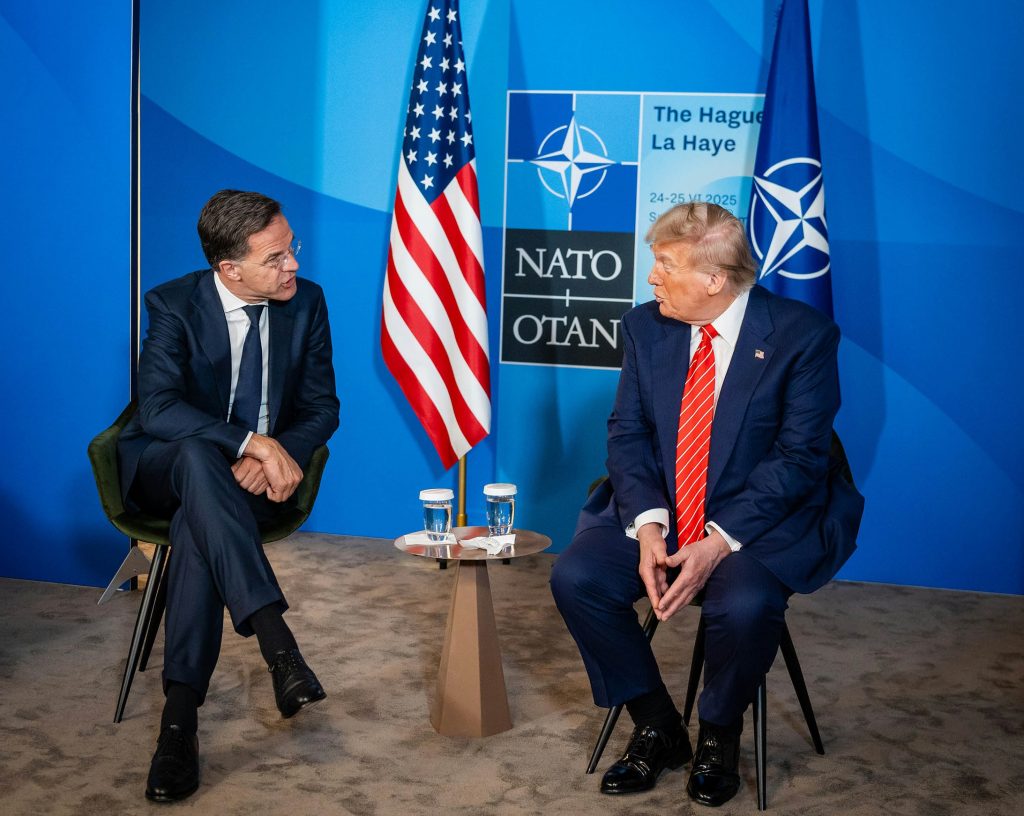
US President Donald Trump declared after the NATO summit in The Hague that he had achieved a “monumental win for the United States” by securing a commitment from European NATO countries to spend an unprecedented 5% of their annual GDP on defence.
“Allies agree that this 5% commitment will comprise two essential categories of defence investment. Allies will allocate at least 3.5% of GDP annually based on the agreed definition of NATO defence expenditure by 2035 to resource core defence requirements, and to meet the NATO Capability Targets. (…) And Allies will account for up to 1.5% of GDP annually to inter alia protect our critical infrastructure, defend our networks, ensure our civil preparedness and resilience, unleash innovation, and strengthen our defence industrial base.” The Hague summit declaration (excerpt)
In return, flattered by the Europeans and NATO Secretary General, Mark Rutte, Trump promised that the United States would defend Europe in the event of a military emergency (Article 5).
But what can Europeans really expect from a US president who makes promises and then backtracks erratically a few days later, apparently with the sole intention of strengthening America?
 European News Journal (ENJ) asked French Air and Space Force Major General (ret.) Jean Marc Vigilant, President of Eurodéfense-France and former Executive Assistant to the Supreme Allied Commander for Transformation in Norfolk, US and before retiring Director of the French War College in Paris.
General, How do you feel about the outcome of the NATO summit in The Hague? Can we trust the promises of the 47th US President on the security of Europe?
General Vigilant: My feeling is that the European allies should not consider that we are back to business as usual.
Despite the US President’s reassurances that he would honour Article 5 in exchange for the allies’ commitment to increase their defence spending, the US strategic priority remains China, not the support of Europe.
Although the US remains in NATO, the American administration carefully removed any substance from this summit by avoiding subjects of fundamental importance to the Alliance, such as security challenges, level of ambition or the transformation of the Alliance.
Therefore, there is no reason to believe that this kind of blackmail of the allies won’t occur again – especially if President Trump seeks further concessions from the Europeans, whom he despises for their perceived weakness.
So, what should Europe do to overcome the evident weakness of its military means and very considerable dependence on the US? Eliminating this will probably take a long time.
General Vigilant: Europeans should reduce their dependence on the United States. This is an entirely achievable goal, provided Europe regains its self-confidence and is willing to engage in great power competition.
Europe has everything it needs to succeed – except time: it is the world’s second-largest economy, home to 550 million people, rich in talent, history, and experience. To prepare for the inevitable drawdown of American forces on the continent, Europe should, in coordination with the US, organise a transitional phase and progressively build up its own military capabilities.
Although NATO is the primary collective defence tool for the Europeans, they should also develop a new and complementary command and control structure that is both more decentralised and resilient, as well as being completely independent from the US, in case our strategic interests do not align.
On 10 July, British Prime Minister Keir Stamer and French President Emmanuel Macron agreed in Northwood to coordinate their nuclear capabilities and give them a European dimension. A supervisory group will determine how to prepare joint decisions. General, does this Franco-British project have a chance of coming to fruition, given the differences in capabilities, dependencies, and decision-making processes? What added value will it bring to European defence?
General Vigilant: The recent decision by the UK and France to enhance coordination of their nuclear deterrents sends a strong signal to Putin and aims to offset growing ambiguity surrounding the US commitment to NATO – despite the reassurances offered at the Hague Summit.
I would argue that, at present, the European nuclear deterrents—namely those of France and the United Kingdom – are more credible and thus more effective in deterring Putin than the US extended nuclear deterrence. As a former master KGB operative, Putin is adept at manipulating egos and could easily exploit Trump’s self-interest to reduce the US commitment to NATO or to EU allies, particularly if it were to entail the risk of strategic retaliation against US territory. On the contrary, Putin does not know how France would respond and cannot count on any US control over the French deterrent.
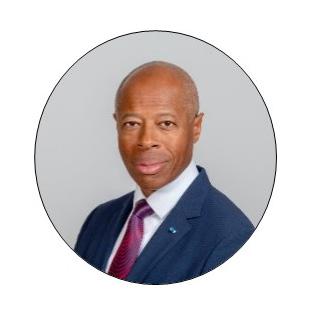 French Air and Space Force Major General (ret.) Jean Marc Vigilant is the current President of Eurodéfense-France. He is the founder and President of BeVigilant Consulting.
© JM@BeVigilant-consulting.com