A personal report by our Middle East correspondent Gerhard Arnold
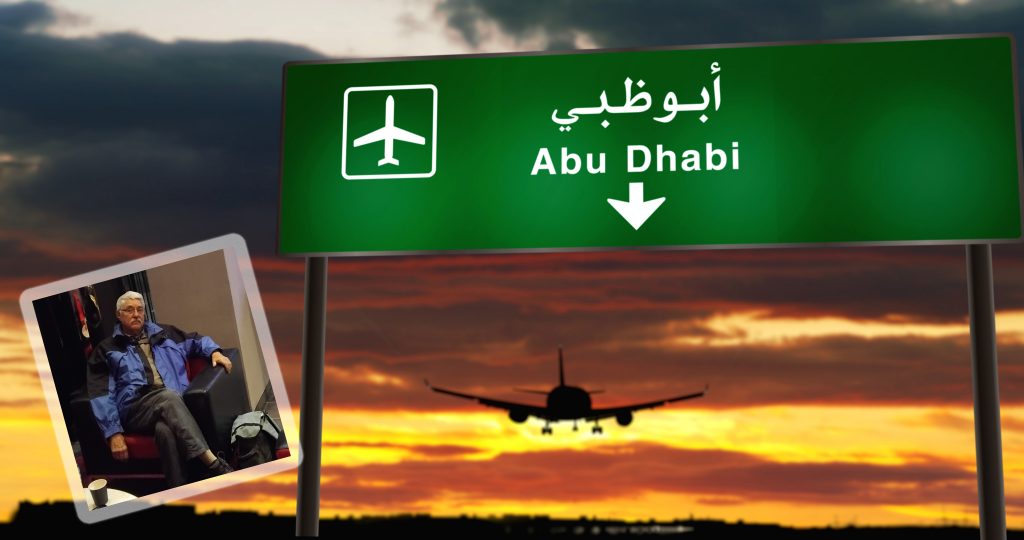
Our group tour of Sri Lanka ended on Friday 27 February 2026. We said goodbye to our fellow travellers at the hotel, as we all had different flights home. My wife and I were hopeful that US President Trump would not launch a military attack before the final round of negotiations with Iran the following Monday in Vienna. We were wrong.
We flew in good spirits from Sri Lanka’s capital to Abu Dhabi on Saturday 28 February, where we had booked a four-day layover. It was the day of the US-Israeli attack on Iran. We landed at midday with the national airline Etihad. Afterwards, the airspace of the United Arab Emirates (UAE), and consequently the capital’s airport, was closed indefinitely.
Of course, my wife and I were worried. We weren’t afraid for our lives, because we didn’t believe the war would spread to the UAE. As a journalist specialising in the Middle East and Arabian peninsula, I was aware of the policy of moderation that the government there had been pursuing toward Iran for years. So why would Iran attack military installations in the Emirates, even if there were US facilities there? The Emirates, Qatar, Oman, Saudi Arabia, and Bahrain publicly declared, immediately after the war began, that no US offensive operations would be permitted from their territory. That reassured me.
However, for reasons I will investigate further, the Emirate of Dubai was subjected to massive rocket and drone attacks from Iran – over 900 missiles in the first three days of the war, according to media reports. To my surprise, the local air defence quickly brought the situation under control and, according to the media, were able to neutralise virtually all of the attacks.
Public life in Abu Dhabi, where our hotel was located in the business district, proceeded as normal. There was no panic-buying in the shops, no sign of unrest. Business was already somewhat quieter due to Ramadan. Unlike in the hard-hit Dubai, we heard something like thunder on Tuesday night. It wasn’t a thunderstorm, but rather explosions of interceptor missiles. About 32 km southeast of Abu Dhabi lies the large Emirati military airport Al Dhafra, where US combat units are stationed. It was shelled night after night. German tourists who were staying near the civilian airport later told me that they had seen the fire trails of the interceptor missiles to the south, near Al Dhafra, from their hotel. They had heard the loud thunderous explosions night after night.
As a specialist of this region, the calm in public life in Abu Dhabi didn’t surprise me. It aligns with the findings of disaster psychology. As long as no hostilities occur in one’s immediate surroundings and state authority is maintained, as long as normal daily life is possible – which was the case in Abu Dhabi – panic doesn’t break out. As long as the government also demonstrates that it cares about its citizens and has the means to protect them, a degree of calm prevails.
My wife and I completed our planned itinerary. However, on the second day of the war, Sunday, 1 March, several museums were closed for security reasons. The Abrahamic Family House, which includes a mosque, a synagogue, and a church, and was built by the government to promote interreligious cooperation, was also closed. We had intended to attend the Catholic service, and we were surprised to find no other people in the vicinity of the entire large complex. A police patrol car droved up and politely but firmly informed us that we should leave the area immediately: “restricted area”, they said.
We learned about our departure options through the German embassy in Abu Dhabi. We could have left overland to Oman and then continued our journey by air. Not exactly a cheap solution, as they told us honestly in an email. There was another option via Saudi Arabia.
Unfortunately, Etihad Airways didn’t provide us with any information. However, our hotel informed us that every evening since Tuesday 3 March, the airline, in conjunction with the government, had been deciding which flights would depart the following day. This list was then sent to all hotels. Passengers wishing to leave the country could register on an Etihad waiting list using a QR code, which we naturally did. That same night, the hotels knew which of their guests were eligible to depart the next day.
The following night, on Thursday 5 March at 2am, the hotel reception informed us that we should prepare to depart. We would be picked up by an Etihad bus at 4am and taken to the airport. There were about 20 hotel guests with whom we travelled in the hope of leaving the country.
As it soon became clear, appearing in person at the airport was the only way to secure a booking for the next flight. Due to the war, bookings well in advance had become impossible. Many passengers who already had confirmed bookings for Frankfurt that day were unable to use them because they had no way to fly to Abu Dhabi and connect to Frankfurt. Their seats remained empty and could therefore be allocated to others.
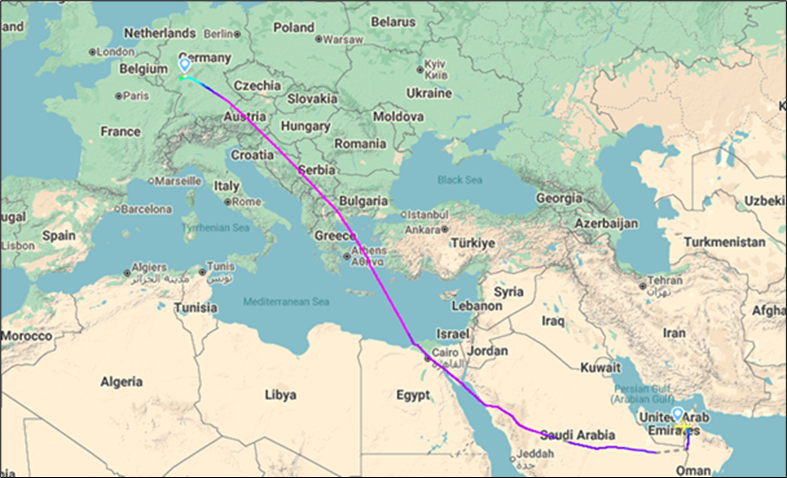
We benefited from this. An Etihad staff member at the passenger counter worked very hard on our behalf, which took a long time, but ultimately proved successful. Other passengers were not so fortunate. Shortly after 2pm, the fully booked Boeing Dreamliner took off, but had to fly a long detour to the south around the war zone. This extended the flight time to almost eight hours.
For me, in my specific professional work, key insights have been confirmed. Given the already existing massive security threats, we in Germany must also be prepared for sudden, large-scale, and even violent attacks on military targets, as well as on critical infrastructure, in the near future. This is evident in the daily cyber-attacks and the terrorist attack on vital power lines in Berlin last winter. The government can prevent premature panic if it conveys to its population the feeling that it is well-prepared and has effective countermeasures in place. In times of war, trust in one’s government is crucial, as is the population’s own preparedness.