By PD Dr ANTJE NÖTZOLD – Senior Researcher and Lecturer, Munich/Chemnitz
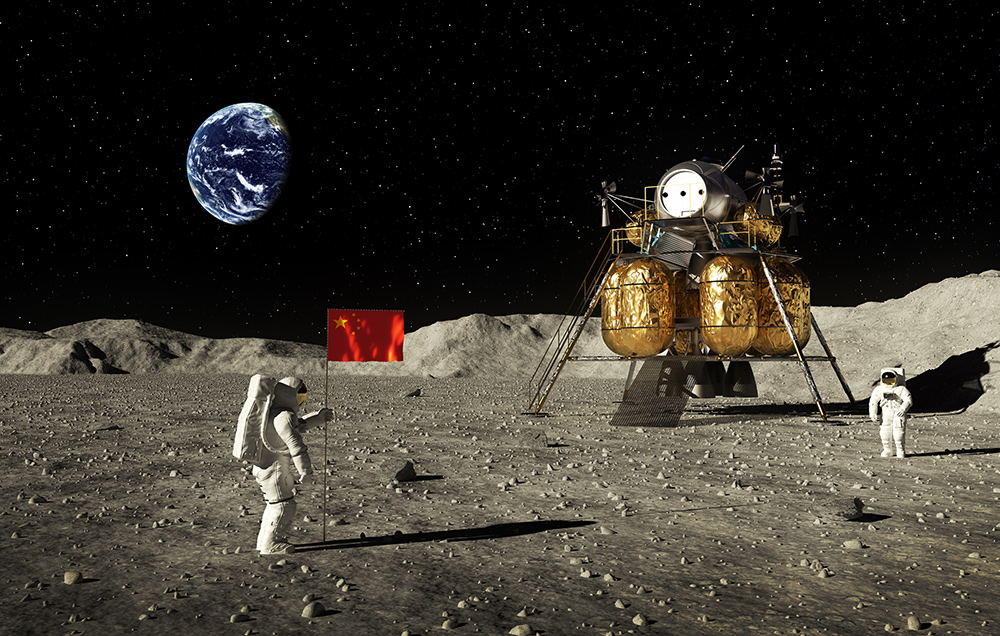
While China’s Space Program 2021 formulated Beijing’s ambitious vision “to strengthen its space presence in an all-round manner” the US National Security Strategy 2022 clearly stated: “America will maintain our position as the world’s leader in space”. Space is part of the Chinese Dream which aims to turn China into a global leader by the 100th anniversary of the People’s Republic. The US is alarmed by this intent to surpass them in space as soon as possible and both clearly feel in a second space race. However, this time, the main objective is not to gain prestige by sending the next human to the moon – that is just the beginning. Whoever wins – and the race is wide open – will gain an important first-mover-advantage regarding a permanent moon basis, space order setting as well as the strategically important cislunar orbit and lagrange points.
Besides, competition in space is taking place in the Earth’s orbits, which are becoming scarce resources instead of endless expanses, particularly in Low Earth Orbit (LEO) and Geostationary Earth Orbit (GEO). The US and China are vying for launching rates, new technologies and the establishment of mega-constellations. While SpaceX’s Starlink plans for 32,000 satellites in space, with already nearly 8,000 active, and the US governmental Starshield is expected to have 10,000, China has started launching the Guowang and Qianfan constellations with 13,000 and 14,000 satellites planned respectively.
“Space is part of the Chinese Dream which aims to turn China into a global leader by the 100th anniversary of the People’s Republic.”
Future space warfare: the risk has become real
Furthermore, space remains of crucial military importance as today it is key for multidomain operations and essential to how states compete and fight in every domain. Advanced and commercial space assets have fundamentally changed the character of combat, enabling real-time warfare with reliance on space on a tactical level and fighting on hypertransparent battlefields. Space is no longer just a critical enabler instead of becoming a warfighting domain on its own. Thus, making space assets a critical weakness and attractive targets is leading to the growing perception within the military that, in future conflict, war will not only be fought with and through space, but also in space.
Holding or challenging “space superiority” is considered a priority, and has already led to an arms race between the major rivaling space powers, who are rapidly improving their counterspace capabilities for temporarily or permanently disrupting the functionality of space assets or even destroying them. While cyber and electromagnetic attacks are already common in conflicts, further advancements in counterspace weapons could facilitate “orbital warfare”. The US Space Force admits in its recently released Framework for Planners on Space Warfighting that “space warfare is a certainty in the future”.
So far, Europe and Germany have remained on the sidelines of geopolitics and astropolitics. Although they have now politically recognised the essential importance of space for their security, there is still a lot of catching up to do for the envisioned strategic autonomy in this domain!
 PD Dr Antje Nötzold is Senior Researcher for “Support for Arms Control in Space” at University of Bundeswehr Munich, University Lecturer in International Relations at Chemnitz University of Technology and Vice-President of the German Society for Security Policy (GSP).
© Daniel Martin-Findeklee